A structured practice session protocol
Unstructured driving — loading the track and lapping until you get bored — produces some improvement. Repetition is its own teacher. But it is slow, and it tends to bake in bad habits alongside good ones, because nothing in the process tells you which is which.
A structured 60–90 minute session with explicit goals and rest intervals produces more improvement per hour than unstructured time on track. Anders Ericsson's research on expert performance calls this deliberate practice: focused, goal-oriented, with feedback. Ross Bentley's Speed Secrets applies it to motorsport.
The 4-block structure
Block 1: Warm-up (10 minutes, 5–8 laps)
Drive at 90% pace. Goals: reacquaint with the track, find your braking references, get tyres up to temperature. Notice which corners feel off — those are your weak candidates for Block 2.
Don't push. A 2-seconds-off-pace warm-up lap is fine. The warm-up is mental, not a time trial.
Block 2: Goal laps (25–30 minutes, 15–20 laps)
This is the deliberate block. Pick one specific thing to work on — and specific enough that you can tell from a single lap whether you executed it.
Good goals:
- "Trail brake into Turn 1 a fraction further."
- "Use 4th gear through the chicane instead of 3rd."
- "Look through Maggotts–Becketts as one unit, not three corners."
- "Settle the rear earlier through Eau Rouge — check throttle ramp."
"Drive faster" is not a goal. "Turn into T1 a half car-length later" is.
For each lap: execute the goal, observe, make a small adjustment, try again. After 15–20 laps you've either internalised the change or determined it doesn't apply. Both are useful conclusions.
Block 3: Rest (5–10 minutes)
Get up. Walk around. Drink water. Look at something that isn't a screen.
This is not optional. Cognitive performance degrades after 30–40 minutes of focused attention. The driver who skips the break and does 90 unbroken minutes performs progressively worse in the second half — slower, more inconsistent, and more likely to crystallise a bad habit because they can't attend to the correction. The break is where learning locks in.
A good use of Block 3: watch a hotlap video of the same track, specifically through the sector you worked on in Block 2.
Block 4: Race-pace simulation (25–30 minutes, 15–20 laps)
Drive a consolidated stint at race pace. Goals: combine the Block 2 technique with everything else, hold consistent pace (not peak pace), manage tyres and fuel as you would in a race.
This is the real test. If the Block 2 technique holds under race-pace cognitive load — which is higher than focused practice — it's yours. If it falls away when you're not consciously attending to it, it's not yet a habit. That's fine: schedule another Block 2 on the same goal next session.
The PaceBoss post-session review
After every practice session, spend 5 minutes in PaceBoss reviewing Block 4's metrics — not Block 2's. The race-pace block is your true skill measure. Focused Block 2 laps are inflated by attention you won't have in a race.
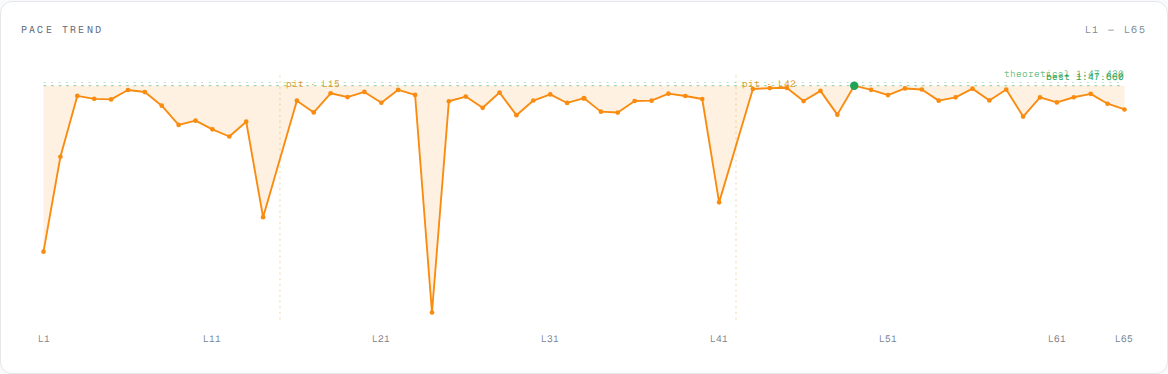
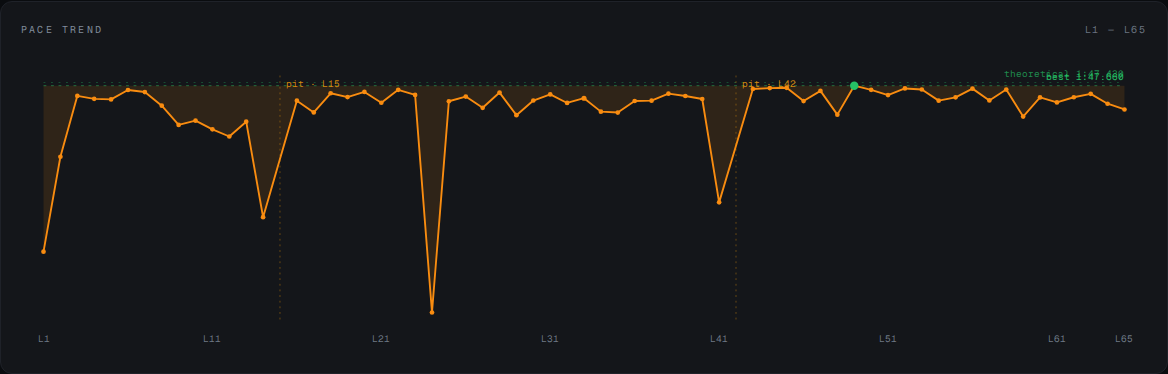
The pace-trend chart is the headline of the post-session review. The shape of the trace tells you what happened across the stint — the deep dips at L15 / L21 / L42 above are pit + cool-down laps; the steady cluster between them is the race pace you'd be reviewing.
Across the corpus of 654 races, the canonical stint shape — averaged across every stint of ≥10 laps — looks like this:
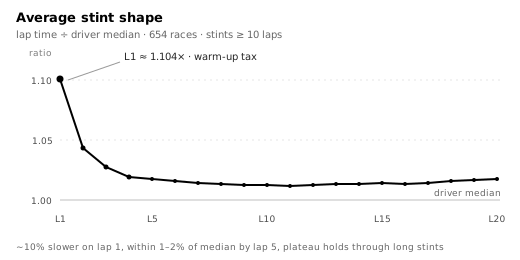
Lap 1 is about 10 % slower than the driver's median across the corpus — the warm-up tax. By lap 5, the typical driver is within 1–2 % of their median rate and stays there through long stints. Block 1's "drive at 90 % pace" advice maps directly to this curve: you're not going to set your fastest lap on lap 1 anyway, so don't try.
Three numbers:
- Best lap. Did peak pace move from your previous session? If yes, you have a new ceiling.
- Consistency percentage. Did the spread tighten? Compare Block 4 to Block 1.
- Sector ranks. Did the sector containing your Block 2 goal improve?
The interpretation matrix:
| Best lap | Consistency | Meaning |
|---|---|---|
| Up | Up | Technique landed and you can repeat it. One more session to consolidate, then move on. |
| Up | Down | You found the time but can't repeat it. Schedule another session — this is about repetition. |
| Flat | Up | Smoother but not faster yet. Often the precursor to a pace step in the next session. |
| Flat | Flat | The goal didn't apply, or the change didn't actually happen. Reconsider. |
| Down | Down | The change is making things worse. Revert. |
This five-minute review is the fastest way to connect each session's goal to a measurable result and decide what to carry into the next session.
Further reading
- Anders Ericsson, Peak: Secrets from the New Science of Expertise — the foundational research on deliberate practice.
- Ross Bentley, Speed Secrets — the racing-specific application.
- Coach Dave Academy — ACC-specific structured practice plans.
Related reading
- Get faster from hotlap videos — what to do during Block 3 rest.
- Learn a new track — the protocol when the Block 2 goal is "learn this track at all."
- Why your pace plateaus — the diagnostic for what to make Block 2's goal be.
questions
- Why is structured practice better than just driving laps?
- Deliberate practice — focused, goal-oriented, with measurement and feedback — produces faster skill acquisition than unstructured time-on-task. The 4-block protocol applies this to sim racing with PaceBoss as the measurement layer.
- Why is the rest block mandatory?
- Cognitive performance degrades after 30–40 minutes of focused attention. Skipping rest means the second half of a session is slower, less consistent, and more likely to crystallise bad habits because you cannot attend to corrections.