Looking ahead: vision and pace
The single piece of advice every real-world racing instructor gives in the first hour of every coaching session: look further ahead.
The drill
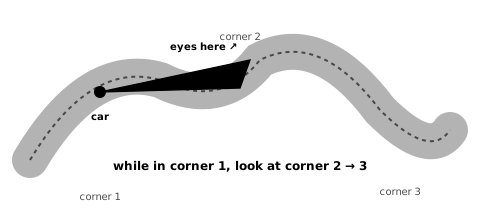
The "look two corners ahead" drill. For an entire session, consciously look past the corner you're in. As you turn into the current corner, your eyes should be on the apex of the next corner. As you reach this apex, your eyes should be at the corner after that.
It feels wrong — like you're not driving the corner you're in. That's the point. The corner you're in gets driven by muscle memory; your conscious attention belongs to the next decision.
Run a session this way. Don't expect peak pace to improve immediately. Then check PaceBoss — did consistency rise? Did sector totals tighten across laps? If yes, the drill is working. If consistency doesn't rise after a full session focused on vision, either the discipline didn't take hold (it's harder than it sounds — try again) or something else is driving the variance.
What it is
In a racing car, your eyes should be looking at the corner after the one you're driving — sometimes two corners ahead. Your hands, feet, and inputs follow your eyes by hundreds of milliseconds. Look at the apex you're approaching and you'll arrive there having made no preparation for what follows. Look at the next braking zone while you're still in this corner, and you're already processing it when you reach it.
Jackie Stewart wrote about this in Winning Is Not Enough — vision was one of the three things he made apprentice drivers practise obsessively. Skip Barber builds the entire first day of instruction around looking past the corner to the corner after. Coach Dave Academy's introductory ACC coaching series opens the same way.
Target fixation goes in both directions. If you look at the apex, you'll hit the apex. If you look at the outside wall, you'll find the outside wall.
Why it makes you faster
Smoother inputs. When your eyes are two corners ahead, you're driving the current corner from muscle memory while your conscious processing is on what's coming. Inputs become smoother because you're not making decisions at the apex; you're executing decisions you made on the way in.
Earlier preparation. Knowing the next braking zone is coming means you start preparing sooner — throttle release, weight shift, gear selection all happen at the right moment.
Better consistency. A driver looking at the apex makes a different decision each lap based on what they see in the moment. A driver looking past the apex makes the same decision each lap based on the geometry of the next corner. This is the most measurable consequence: consistency rises before peak pace rises.
What PaceBoss can show you
PaceBoss can't see your eyes. But the downstream signature of learning to look ahead shows up in the data:
- Consistency percentage rises before best lap rises. A driver transitioning to ahead-looking gets steadier across laps before they get faster. The pace-trend chart shows this as a narrowing trace spread without the bottom line dropping much.
- Sector variance narrows in multi-corner sectors. Especially sectors with direction changes. A driver looking corner-by-corner will have variable sector times; a driver looking ahead executes the sector as a chunked unit and the total stabilises.
Common ACC examples
The first sector at Spa-Francorchamps. La Source → Eau Rouge → Raidillon is three corners that must be driven as one chunked unit. Looking only at La Source means you're underprepared for the steering through Eau Rouge. Looking through Eau Rouge to the top of Raidillon is what experienced Spa drivers do.
Maggotts–Becketts–Chapel at Silverstone. Five direction changes in ten seconds. Apex-by-apex driving produces wheel-sawing; ahead-vision produces one fluid action.
The Esses at Suzuka. Eight high-speed direction changes that must be driven looking ahead. Corner-by-corner is impossible at race pace.
The Mountain at Bathurst. Reid Park → Sulman → McPhillamy crests blindly; you have to know the next corner before seeing it because your line of sight is blocked. Looking ahead here means knowing what's coming.
Further reading
- Jackie Stewart, Winning Is Not Enough — vision discipline as one of his three pillars.
- Ross Bentley, Speed Secrets — the chapter on vision and the eyes-feet-hands chain.
- Skip Barber Racing School — vision-first instruction methodology.
Related reading
- Get faster from hotlap videos — what to watch for in alien onboards (their head and camera movement is the vision tell).
- Consistency in racing — the metric vision technique improves first.
- The grip envelope — what looking ahead enables: smoother corner execution.
questions
- Where should I be looking when driving in ACC?
- At the corner after the one you are currently in. Your hands and feet drive the current corner from muscle memory; your conscious attention belongs to the next decision. This is what every real-world racing instructor teaches first.
- How does looking ahead improve consistency?
- A driver looking corner-by-corner makes a different decision each lap. A driver looking ahead makes the same decision each lap based on the geometry of the next corner. Consistency rises because the decisions are identical.