Consistency in racing: what does the percentage actually mean?
In a one-lap qualifying session, peak pace wins. In a 30-lap race, consistency wins. A driver who alternates between 1:33.0 and 1:36.0 averages 1:34.5 — and their rival who runs 1:33.8 every lap wins, even though the inconsistent driver's best lap is faster.
PaceBoss surfaces a consistency percentage on every driver-detail page. Understanding the formula turns a number that can feel arbitrary into a diagnostic tool.
The formula
PaceBoss prefers the consistency value SimResults publishes when it's present (the source of truth for official championship pages). When it's missing — usually for shorter sessions — PaceBoss falls back to the coefficient of variation:
consistency % = 100 − (stddev / mean) × 100
Where stddev is the population standard deviation of your valid lap times and mean is the average of those same laps.
A driver whose every lap is identical has stddev = 0, so consistency = 100%. A driver whose laps vary widely has a higher stddev relative to mean, and consistency drops accordingly.
What the data shows
Across 23,947 entries from 654 valid races, the consistency-percentile distribution is:
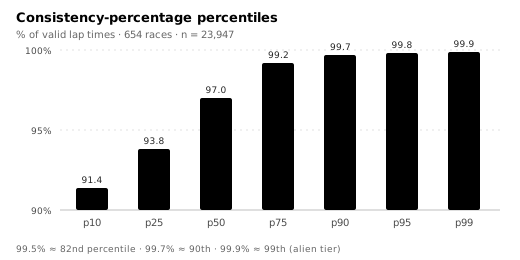
The median ACC entry runs at 97.0% consistency. The "elite 99.5%" line sits at roughly the 82nd percentile — you can be in the top fifth of the field on consistency without being elite. 99.7%+ is genuinely elite (top 10%); 99.9%+ is the alien tier (top 1%).
What the percentage feels like in practice
For a 90-second lap — use these against the corpus percentiles above:
- 99.5%+ — sub-450ms standard deviation. Elite (≈82nd percentile). Your fastest and slowest valid laps are within ~1 second of each other across the entire session.
- 99.0–99.5% — 450–900ms stddev. Strong amateur. Most laps within a couple of tenths of average, occasional half-second wobbles.
- 98.0–99.0% — 900ms–1.8s stddev. Mid-pack. Identifiable "fast" and "slow" laps.
- 97.0–98.0% — 1.8–2.7s stddev. Inconsistent. Likely a few good laps and several scrappy ones.
- <97.0% — 2.7s+ stddev. Either a long strategy session or genuine instability.
These aren't hard cut-offs. A 60-second sprint at Mount Panorama has more absolute variance than a 90-second lap at Imola. The percentage normalises for lap length, but the human read is contextual.
Where the number can mislead
- Pit laps inflate the stddev. PaceBoss filters out pit-in/pit-out laps (anything >1.5× your median) before computing, so a routine pit stop doesn't count. But a slow in-lap that's still under 1.5× will count.
- Strategy variance looks like inconsistency. A driver running a longer first stint on harder tyres has slower laps mid-run, faster at the end. That's valid strategy, not inconsistency.
- Short sessions are unreliable. With three valid laps, the stddev is meaningful but high-variance. PaceBoss requires at least two valid laps to compute.
How to use it
If your consistency is below where you want it:
- Look at the pace-trend chart's shape. Is the variance random (technique) or trended (tyre degradation, fuel saving)? A flat-bottomed trace with occasional spikes = isolated mistakes. A V-shape = warmup or strategy.
- Sort the laps table by sector. If S2 has high variance and S1 and S3 don't, you have one section within S2 where you're inconsistent. PaceBoss can isolate it to the sector but not to a specific corner — for that, drive the sector against an in-game ghost or watch your replay against a steadier driver.
- Compare to your competitors. If your consistency is 99.0% and the race winner's is 99.6%, you're losing the race in the gap between those numbers — not in peak pace.
Related reading
- Theoretical best lap, explained — the related "what could you have driven?" ceiling.
- Pace bands explained — sector-level deltas that often reveal which sector is dragging consistency down.
- Find your pace deficit — turning a low consistency reading into a specific sector to attack.
questions
- How is consistency calculated in PaceBoss?
- PaceBoss uses the consistency value SimResults publishes when available. When missing, it computes: 100 − (stddev / mean) × 100, where stddev is the population standard deviation of your valid lap times.
- What is a good consistency percentage in ACC?
- 99.5% or above is elite for a 90-second lap. 99.0–99.5% is strong amateur. Below 98% means identifiable fast and slow laps that will cost you positions over a 30-lap race.
- Why does consistency matter more than peak pace in a race?
- A driver alternating between 1:33.0 and 1:36.0 averages 1:34.5. Their rival running 1:33.8 every lap wins, even though the inconsistent driver's best lap is faster.