The grip envelope: why you can't brake hard and turn hard
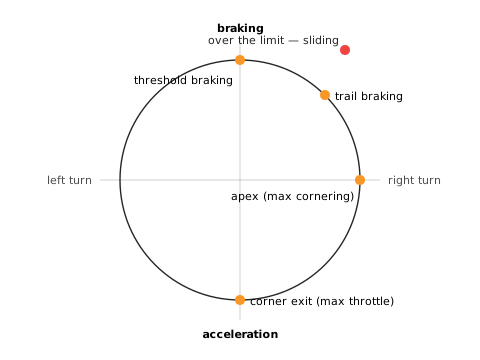
A tyre has a finite friction budget at any instant. That budget is shared between braking, cornering, and accelerating. Use 100% for braking and you have nothing left for cornering. Use 70% for each simultaneously and you stay inside the budget. Try to use 100% for both at once and the tyre slides.
This is the friction circle — the foundational model of vehicle dynamics. PaceBoss can't measure slip angle or tyre load directly (there's no telemetry), but the grip-envelope mindset explains what PaceBoss's sector data is actually telling you.
What the grip envelope is
At any corner, the tyre's friction budget is split across three demands: longitudinal (accelerating or braking), lateral (cornering), and combined (anything in between). The budget is a circle (or an ellipse — front and rear axles can have different limits). The moment you try to exceed its boundary, the tyre slides.
The textbook treatment is in Milliken & Milliken's Race Car Vehicle Dynamics (1995). Bentley's Speed Secrets covers the practitioner version: the tyre has a set amount of grip, and the steering wheel, brake pedal, and throttle are three demands competing for it.
Why respecting it makes you faster
The grip envelope is descriptive, not prescriptive. But it reframes common mistakes:
- Locking up on entry — more friction demanded for braking than the tyre has, often because you started turning before fully releasing the brake.
- Understeering mid-corner — you've asked the front tyres for cornering grip they don't have, because you're carrying too much speed for the lateral budget.
- Snap oversteer on exit — you've added throttle past the rear tyres' combined budget; they slide longitudinally, then unload laterally.
- Wide on exit — you've used the front tyres' lateral grip mid-corner, leaving nothing for staying on line as you add throttle.
Each of these is the same failure mode: more demand than supply. Trail braking works because it stays inside the envelope. A late apex works because it lets you spend more of the envelope on lateral grip during the slow phase and shift to longitudinal grip on exit.
What PaceBoss can show you
PaceBoss can't see slip angle, brake pressure, throttle position, or steering rate. What it shows, when you exceed the grip envelope habitually:
- One sector consistently slow vs the cohort. The SectorsChip thermometer is half-empty for that sector and full for the others. Necessary, not sufficient — PaceBoss can't tell you whether it's understeer mid-corner or overbraking on entry.
- High lap-to-lap variance (low consistency). Scattered laps on the pace-trend chart. Sometimes you find the envelope; sometimes you exceed it and slide.
- Theoretical best close to raw best. You have one lap that hit the envelope just right, and your typical pace doesn't get there consistently.
Each of these is consistent with a grip-envelope problem, not proof of one. The localising step — which corner, which axis — needs the in-game replay. TC activation (throttle-side demand exceeded), ABS activation (brake-side demand exceeded), and tyre-slide indicators are the replay signals that tell you what's happening within the sector PaceBoss flagged.
Common ACC examples
Eau Rouge–Raidillon at Spa. The line load goes through compression. Drivers exceed the envelope mid-uphill by carrying too much steering angle, scrub momentum, lose speed onto Kemmel. The fix is a tighter line earlier so you don't need lateral grip at the compression peak. Lost time shows up in S2.
Parabolica at Monza. Long-radius right where understeer eats the lap. Drivers asking for too much front grip mid-corner blow the line at exit; the rear gets light, throttle is delayed onto the straight. Lost time shows up in S3, not S2 where the corner technically is.
The chicane at Suzuka (Casio Triangle). Combined-demand corner: brake + turn + brake again. ABS firing on the second brake is the signature — the first brake released too early, so the car wasn't slow enough before the second steering input demanded lateral grip.
Further reading
- Milliken & Milliken, Race Car Vehicle Dynamics (1995) — the SAE textbook on the friction circle.
- Ross Bentley, Speed Secrets — the practitioner version. The chapter on the friction circle is short and excellent.
- Driver61 YouTube — visual explanations of grip and balance with telemetry overlays.
Related reading
- Trail braking explained — the technique that exists because of the friction circle.
- Throttle modulation — the corner-exit half of the envelope problem.
- Glossary: pace band — the colour palette PaceBoss uses to flag sector deltas.
questions
- What is the friction circle in racing?
- A model from vehicle dynamics: a tyre has a finite friction budget shared between longitudinal forces (braking and acceleration) and lateral forces (cornering). You can use 100% for one or split across both, but the total cannot exceed the budget.
- What does PaceBoss show when I am exceeding the grip envelope?
- A sector that is consistently slow relative to the cohort, high lap-to-lap variance (low consistency), or a theoretical best that is close to your raw best but well below the cohort. The in-game replay shows the cause within the sector.