Theoretical best lap, explained
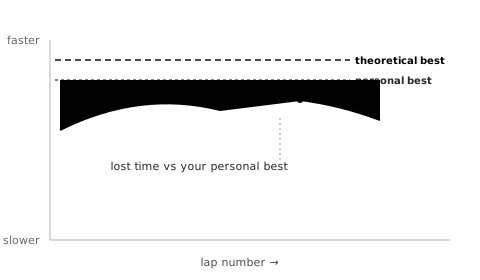
Theoretical best is the lap time you could drive if you stitched together your fastest sectors. PaceBoss surfaces it on every driver-detail page as a dashed reference line above your best lap on the pace-trend chart. It's the most-asked-about number in the glossary — mostly because it sounds like magic until you see how it's calculated.
How it's computed
Every track in ACC has three sectors (S1, S2, S3). PaceBoss looks at every valid lap a driver completed in the session, takes the fastest split for each sector independently, and sums them:
theoreticalBestMs = bestS1Ms + bestS2Ms + bestS3Ms
If your fastest S1 came on lap 4, your fastest S2 on lap 11, and your fastest S3 on lap 17, the theoretical best is the sum of those three — even though you never drove that lap. Only valid laps contribute. Pit laps (>1.5× median lap time) and laps marked invalid are excluded.
Why it matters
It's a ceiling. The theoretical-best line shows what's available if you drove cleanly through every sector in a single lap. If your best lap is 200ms slower than the theoretical, you have 200ms to find by doing what you've already proved you can do — not by going faster, but by combining what you've already shown.
The delta tells you where consistency lives. A driver with a 1.5-second gap between best lap and theoretical best is wildly inconsistent across sectors — they have one fast sector at a time. A driver with a 50ms gap is driving near their peak every lap. The first driver has headroom; the second needs a technique step to find more time.
When theoretical best lies
Theoretical best is honest about your sectors but can lie about raceable pace:
- One purple sector inflates it. If you got a tow down the long straight and posted a one-off S2 a half-second faster than every other lap, the theoretical best dropped by a half-second — but you can't repeat it without the tow.
- It's not realistic in race conditions. Tyre wear, fuel weight, traffic — theoretical best is calculated against your fastest sectors regardless of when in the session they came. The first qualifying lap on fresh tyres often contributes the fastest splits.
- Sector boundaries are an abstraction. A theoretical-best lap that combines S3 of one lap with S1 of the next isn't physically possible as a continuous lap. PaceBoss sums the three best sectors regardless of their lap origin.
Theoretical best vs personal best
PaceBoss's pace-trend chart draws both as dashed reference lines, with theoretical best slightly above personal best. The shaded area between your trace and your personal best is lost time — every lap, every sector. The gap between personal best and theoretical best is uncombined potential — the time you've shown you have but haven't yet strung into a single lap.
When the two lines are close, you're driving near your peak. When they diverge, the gap is your homework.
Related reading
- Find your pace deficit — workflow for turning the theoretical-vs-best gap into a specific sector to attack.
- Consistency in racing — the related "how steady are you?" number that appears alongside theoretical best.
- Pace bands explained — the colour palette on the SectorsChip that complements the theoretical-best line.
questions
- What is theoretical best lap?
- The sum of your fastest S1, S2, and S3 sector splits across all valid laps in a session, even if those sectors came from different laps. It is the lap you could have driven if you had combined your best sectors.
- Why is theoretical best different from my actual best lap?
- Because your fastest S1 and your fastest S3 probably did not happen in the same lap. The theoretical best shows how much time you have already proved you can find — you just have not combined it yet.
- When does theoretical best lap lie?
- When one sector was inflated by a one-off event (a tow down the straight, a fresh-tyre first lap). That single purple sector pulls the theoretical best down without being repeatable.