Pace bands explained: from elite to off-pace
PaceBoss colours every per-lap and per-sector delta with a five-band palette: excellent, good, ok, bad, terrible. The bands aren't aesthetic — they're calibrated against gap to the cohort's best, with thresholds picked to map onto how a sim racer actually feels their pace.
The thresholds
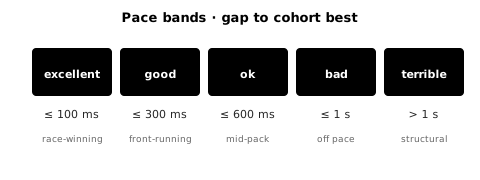
The bands are defined as gap-to-reference in milliseconds:
| Band | Delta | What it means |
|---|---|---|
| excellent | ≤ +100 ms | Within a tenth. Race-winning pace. |
| good | ≤ +300 ms | Within three tenths. Front-running pace. |
| ok | ≤ +600 ms | Within six tenths. Mid-pack pace. |
| bad | ≤ +1000 ms | Within a second. Off the pace. |
| terrible | > +1000 ms | Over a second. Way off. |
These are sector-level thresholds. PaceBoss uses them on the SectorsChip thermometers, the driver-detail pace-trend chart's per-lap dots, and anywhere else a per-lap delta surfaces. They're not the right thresholds for cross-track gaps to the field — there, PaceBoss uses percentage-based bands instead (see the /me view per-track chips).
Why these exact numbers
100ms is the perceptual floor for "I drove that one." Most drivers can sense when they're a tenth off; below that, the variance is noise. Excellent captures the laps where the driver was visibly on it.
300ms is the threshold where lost-time becomes structural. A driver consistently 250ms off the front isn't making one mistake per lap — they have a setup or technique gap that needs work. Good is "I'm in the fight, but a competitor is doing something I'm not."
600ms is mid-pack. Ok is the band where most drivers in a typical league live. Not slow, not fast — the median.
1000ms is one second. The threshold matters because in a typical 30-lap race, a 1-second-per-lap deficit is 30 seconds at the flag — a full lap-per-hour deficit. Bad is where you stop racing the leader and start racing for points.
Beyond 1 second, the delta is qualitatively different. Terrible isn't an insult; it's signalling "this is a structural mismatch — wrong car, unfamiliar track, broken setup, or you should be in a slower class." Most drivers see this band on tracks they've never raced.
How PaceBoss colours them
The bands map to five colours from green (excellent) through red (terrible), tuned for both light and dark mode separately so the same band reads with similar visual weight regardless of theme.
In the pace-trend chart, each lap's dot is coloured by its band relative to the cohort best. In the SectorsChip, each thermometer's height is its band converted to a fill percentage. In the per-track chips on /me, the chip's whole background gets a faint tint at the band's colour at ~6–7% opacity.
Cohort-relative is the key
A 200ms gap means different things in different contexts. PaceBoss handles this through the cohort concept (covered in the glossary).
In a single-class race, the cohort is the whole field. In a multi-class race, the cohort defaults to your class only. This matters because a GT4 driver's "good" pace looking at a GT3 cohort would always be "terrible" — but against their own class, they might be at the front.
The cohort toggle in the driver-detail hero switches between class and overall. The pace bands re-compute against the new reference, so the same lap can be "good" against your class and "bad" against the overall field.
What the data shows
Across 654 valid races (36,816 entries), the long-tail bias is real:
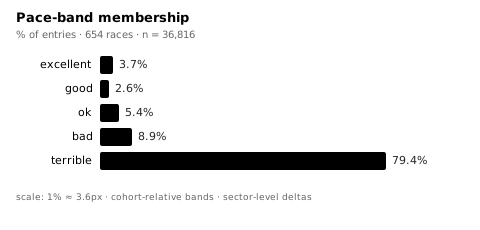
Roughly 80 % of entries land in terrible — more than a second off the cohort lap leader. That's a feature of cohort-relative bands more than a verdict on most drivers: by definition the cohort best is alien pace, and most of the field sits behind it. The right way to read this chart is as the canonical shape of an open GT3 lobby, not as a skill verdict on the median driver.
What pace bands aren't
- They aren't a skill rating. A driver who's "excellent" in a slow league might be "ok" in a fast one. The bands measure your gap to this specific cohort in this specific session.
- They aren't a replacement for the absolute time. Bands compress information. PaceBoss always shows the actual delta in formatted ms next to the colour cue, so the band reinforces rather than replaces the number.
- They aren't a season ranking. For "where do you stand at this track over time," see the per-track chips on
/me— those use percent-of-field-PB, a different (and more cross-track-comparable) metric.
Related reading
- Find your pace deficit — workflow for using the pace-band thermometers to isolate where you're losing time.
- Theoretical best lap, explained — the dashed reference line that complements the per-sector bands.
- Glossary: cohort — what "the cohort" means when computing band thresholds.
questions
- What do the colours on the PaceBoss sector thermometers mean?
- Green (excellent) means within 100ms of the cohort best. Teal (good) is within 300ms. Yellow (ok) is within 600ms. Orange (bad) is within 1 second. Red (terrible) is more than 1 second off.
- Why does PaceBoss use class-relative pace bands in multi-class races?
- A GT4 driver should not be told they are 10 seconds off pace because GT3 cars exist. By default, pace bands compare you against your class cohort. The cohort toggle in the driver hero switches to overall-field comparison.