Trail braking, explained
Trail braking is the technique of carrying brake pressure past turn-in — easing off the brake gradually as you add steering angle, rather than finishing all braking in a straight line and turning as a separate action. It's how nearly every fast lap in nearly every car is driven through nearly every corner that benefits from rotation.
It's also one of the most common reasons your entry-heavy sector is slower than the cohort's. PaceBoss can't see your brake pressure — there's no telemetry — but it can show you the sector signature, and this page covers the technique, the physics, and what to do with that reading.
What it is
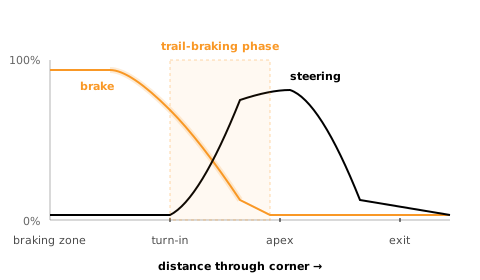
Conventional braking: brake hard in a straight line, release fully, turn. Trail braking: brake hard in a straight line, then ease off the brake as you turn in, dragging some pressure into the corner past turn-in. The brake release isn't a switch; it's a ramp that mirrors the inverse of the steering input.
Mark Donohue documented this in The Unfair Advantage (1975) as "trailing" the brake into the corner to keep the front tyres loaded while changing direction. Ross Bentley's Speed Secrets formalises it as a teachable skill.
Why it makes you faster
Both reasons are grounded in the grip envelope:
Front-axle loading. Braking transfers weight forward onto the front tyres. Loaded front tyres have more lateral grip — if you fully release the brake before turning, the weight transfers back, the fronts unload, and you've discarded the rotation they would have given you. Trail braking keeps the front loaded into rotation.
Earlier rotation, later apex. Because the front tyres are gripping harder under residual brake pressure, the car rotates with less steering input. You can turn earlier and tighter, pointing the car for an earlier throttle application.
Where trail braking matters most: slow hairpins (large speed drop, tight mid-corner radius), medium-speed entry corners with rotation needs, and combination corners where a second brake is needed mid-corner.
Where it's not the move: fast sweepers (the car needs to be settled, not rotating), long-radius constant-arc corners where commitment beats modulation.
What PaceBoss can show you
- Entry-heavy sector consistently slow vs the cohort. The SectorsChip thermometer for S1 is half-empty while S2 and S3 are full. This tells you which sector; the replay tells you what's happening within it.
- Variance in S1 across laps. Some laps you nail it; some you don't. If S2 and S3 are stable but S1 swings 0.2–0.5s, you have inconsistent entries — often inconsistent brake-release modulation.
- Theoretical-best gap concentrated in S1. Your best S1 is much faster than your typical S1. You've shown you can do it; you're not doing it consistently.
What you do with the reading
- Load a fast ghost. ACC's Ghost Mode lets you drive against the session's fastest lap. Watching the ghost through your slow sector shows you the visual gap as you fall behind.
- Watch the brake bar in your replay. If your brake bar drops to zero before turn-in, you're not trail braking. If it tapers smoothly from 80% to 0% over the period from turn-in to apex, you are.
- Listen for ABS activation. If ABS fires while you're turning, you're asking for too much combined demand — trail braking is being mishandled. Ease off brake pressure faster as you add steering.
If your replay shows you're already trail-braking and S1 is still slow, the problem is elsewhere — turn-in point, brake reference marker, line — and the localising shifts accordingly.
Common ACC examples
Turn 1 at Monza. Hard braking from 320+ km/h into the first chicane. Aliens trail brake well into turn 1 to rotate for the second apex; most drivers lose 0.2–0.3s by releasing too early and understeering to the second apex.
Adelaide hairpin at Bathurst. The slowest corner on the lap. Trail braking past turn-in is essential for rotation. ABS firing here is the tell — you're carrying too much pressure for the steering angle you're adding.
Bus Stop at Spa. A chicane that rewards trail braking through the first apex to set up the second. Releasing the brake fully on entry leaves you straight-lining the second apex with no rotation.
The Karussell at the Nordschleife. Extreme trail braking required to settle the car into the banked section. Get this wrong and the car arrives sideways.
Further reading
- Mark Donohue, The Unfair Advantage (1975) — the original first-person account.
- Ross Bentley, Speed Secrets — the braking chapter.
- Driver61's trail-braking video — visual explanation with telemetry overlays.
- Coach Dave Academy — ACC-specific coverage by car class.
Related reading
- The grip envelope — the friction-circle theory that makes trail braking work.
- Threshold braking — the straight-line braking that precedes the trail-off.
- Find your pace deficit — workflow for using PaceBoss's sector reading to localise issues.
questions
- What is trail braking?
- Carrying residual brake pressure past turn-in and easing it off gradually as you add steering, rather than finishing all braking in a straight line. It keeps the front tyres loaded during rotation, which helps the car turn.
- How do I know if trail braking is my issue in PaceBoss?
- If your entry-heavy sector (usually S1) is consistently the slowest thermometer on the SectorsChip while S2 and S3 are competitive, and that deficit is spread across most laps rather than one bad lap, entry braking technique is the likely cause.